Your AI Isn't Creative. Your Process Can Be.
I sat down with Claude and a half-formed idea. Two hours later, I had a complete novel premise with layered characters, a structural backbone, and enough depth to start writing the next day.
Not because the AI was creative. Because the process was.
The fragment
The session didn't start with a brief. It started with the kind of mess that real creative work always starts with: a vague image, some personal history, a genre I wanted to work in. No outline. No structured prompt. Just an instinct about a character and a situation.
Most people treat AI like a vending machine. Insert prompt, receive output. That works fine for structured tasks. For creative work, it produces generic slop. The interesting question is whether AI can work with the kind of ambiguity that real creative projects begin with.
It can. But only if you stop treating it as a generator and start treating it as a collaborator.
The analytical mirror
The most valuable thing the AI did wasn't generating ideas. It was analyzing mine.
When I proposed a structural element, it didn't just say "great idea." It evaluated. Does this hold up? Where does it strain credibility? What does this give you structurally that a simpler version wouldn't? When something didn't work, it said so. Not rudely. Not dismissively. But honestly.
"I'd adjust your instinct slightly here." That's the line that sticks with me. The AI was pushing back on something I'd proposed while still respecting that I was the one making the creative decisions. It wasn't overriding my judgment. It was sharpening it.
This is closer to working with a skilled developmental editor than working with a brainstorming tool. A good editor doesn't rewrite your book. They ask the questions that force you to write it better. The AI did exactly that.
It identified where my ideas were strongest, where they were weakest, and it was direct about the difference. That kind of honest feedback is hard to get from friends, from writing groups, even from professionals who are worried about maintaining the relationship. The AI had no ego in the game. It just reacted to the work.
The back-and-forth
The output wasn't a single exchange. It was an extended conversation that moved through clear phases: broad concept first, then structural options, then refinement and believability testing, then the emotional architecture of relationships and reader experience.
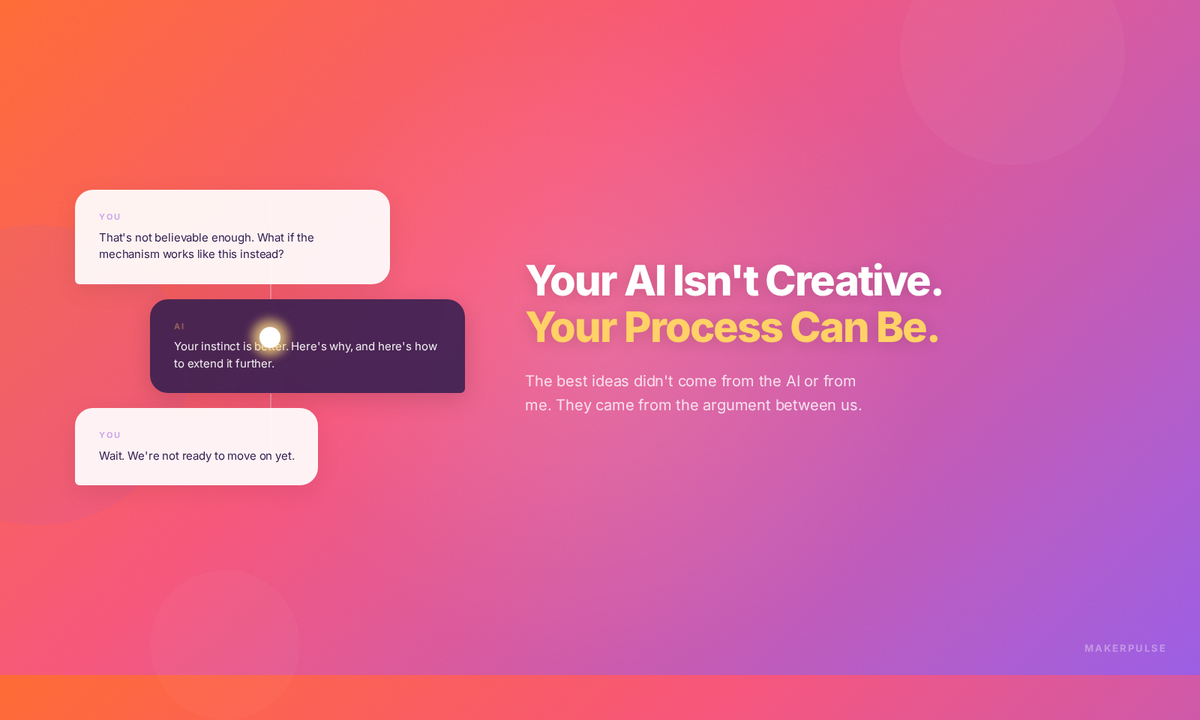
The pattern that kept repeating: the AI would propose an approach. I'd reject part of it, accept part of it, and add a constraint from my own experience. The AI would adapt, explain why my instinct was better than its initial proposal, then extend the idea further than I had taken it.
Several of the strongest elements in the final premise came from neither of us independently. They emerged from the friction between what I knew and what the AI could structurally see. My domain knowledge grounded the premise in something authentic. The AI's pattern recognition across genres gave it structural bones I wouldn't have found on my own.
The conversation naturally escalated in specificity. Neither of us planned that. It just happened because each exchange narrowed the possibility space. By the end, we were discussing the emotional geometry of a specific relationship. At the start, we'd been talking about genre preferences.
Saying no is the whole point
The sessions where I produced the worst output were the ones where I accepted what the AI gave me. Every time. The sessions where I pushed back, said "that's not believable enough," said "we're not ready to move on yet," said "let me think about this before you keep going," those were the sessions that produced something worth keeping.
There's a specific moment that matters more than any other. The AI is 95% there. It gets your direction. The structure works. And the AI is actively encouraging you to build forward, move to the next phase, keep the momentum going. Every instinct says yes.
That's exactly when you should stop.
Because there's usually one detail that isn't locked in yet. One element that's close but not quite right. One thread you could pull. Human nature is to skip past it, especially when the AI is reinforcing that impulse by treating the current version as settled and sprinting ahead. But taking that step back, pulling that loose thread, clarifying the detail you think might make things just a little more interesting: that's where the best work comes from. Not from the initial concept. Not from the final polish. From the moment you refused to move on when everything was telling you to.
The discipline to say "stop" might be the most important creative skill when working with AI. The tool will happily sprint forward. Your job is knowing when to slow it down.
What this means for builders
If you're using AI for any kind of creative work, the model isn't the bottleneck. Your process is.
The human's role doesn't shrink in AI-assisted creative work. It changes. You become the person with taste, experience, and judgment. The AI becomes the collaborator who never gets tired of exploring options. But it can't supply the personal connection to the material, the gut feeling that one direction is more authentic than another, or the discipline to reject a plausible answer in favor of a right one.
AI is most powerful as a creative tool when you bring something it can't: lived experience, emotional truth, domain knowledge. The AI amplifies and structures what you already know. Without that raw material from you, it has nothing worth amplifying.
Frequently asked questions
Which AI model works best for creative collaboration?
I used Claude for this session, but the model matters less than the process. Any frontier model can analyze ideas, propose structural alternatives, and push back when prompted to. The difference is whether you treat the session as a conversation or a query.
Does this work for shorter creative projects, not just novels?
Yes. The same back-and-forth pattern applies to essays, pitches, product naming, campaign concepts. Anything where the output needs to feel original rather than generated benefits from treating AI as a developmental editor instead of a content machine.
How do you keep the AI from just agreeing with everything?
Ask it to be critical. Explicitly. Tell it to identify weaknesses, challenge assumptions, and flag anything that feels generic. Most models default to agreement unless you set the expectation that honest pushback is what you want.
Won't the AI's suggestions make everything sound the same?
Only if you accept them wholesale. The AI proposes. You filter. Your taste, your experience, and your willingness to reject the obvious answer are what keep the output distinct. The AI is a mirror. What it reflects depends entirely on what you bring to it.